What Amanda Peet learned—and wants us all to remember—about cancer
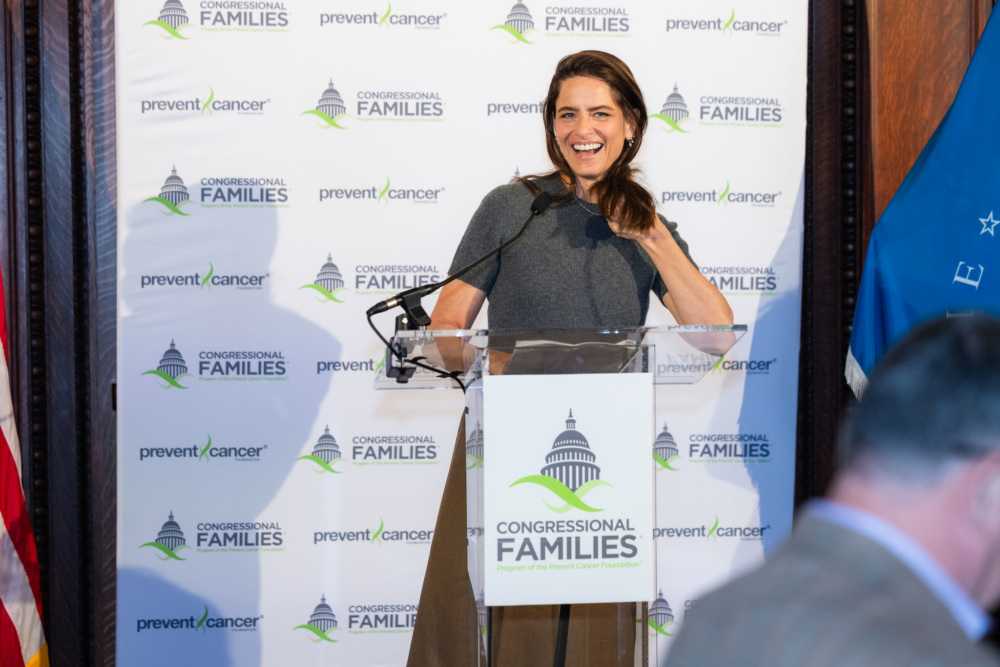
“Nothing brings people together like a common enemy and as we know, cancer is the emperor of all maladies.” Actor, writer and advocate Amanda Peet shared those words as she reflected on her breast cancer journey.
Peet was diagnosed in the fall of 2025. In a personal essay for The New Yorker, she wrote about something many of us understand all too well: When life gets busy, it’s easy to let your health slip to the bottom of the list. But for Peet, staying on top of her health made all the difference.
How early detection shaped her diagnosis
She had long known she had dense breasts—meaning her breast tissue appears solid white on a mammogram rather than clear like typical fatty breast tissue. Because cancer also appears as white on a mammogram, this can make signs of breast cancer harder to detect. Having dense breasts also increases your risk of developing cancer in the first place.
All women ages 40 and older should get screened annually for breast cancer through a 2D or 3D mammogram. People with dense breasts, however, often need more frequent screening or a screening method with higher sensitivity than a standard mammogram, such as a magnetic resonance imaging (MRI).
Since Peet was aware of her dense breasts and knew she was at increased risk for breast cancer, she met with a breast surgeon every six months to get routine check-ups.
Just before Labor Day weekend 2025, her doctor found something during one of these routine appointments and ordered a biopsy, which confirmed a small tumor in her breast.
Shortly after, Peet was diagnosed with lobular breast cancer, a form of breast cancer that begins in the lobules where milk is produced. Lobular cancer rarely forms a distinct lump and can be difficult to spot on a mammogram—making Peet’s commitment to regular screening even more critical. Thankfully, her prognosis was good, and she was able to be treated with a lumpectomy (surgical removal of the cancerous lump and surrounding area) and radiation.
Peet’s breast cancer story turned to advocacy
Peet was honored with the Excellence in Cancer Awareness Award from the Prevent Cancer Foundation’s Congressional Families® Program at the 33rd Annual Action for Cancer Awareness Awards Luncheon. She accepted the award on September 24, 2026, speaking candidly about her experience and the many layers of her cancer journey.
“I was extremely lucky from the get-go,” Peet said in her remarks to an audience of members of Congress, congressional spouses, industry partners and Foundation staff. Peet noted detecting her cancer early was key and helped ensure the cancer could be treated before it became more advanced.
Peet acknowledged she also had resources and advantages that others don’t. She had health insurance and never had to worry about the cost of additional scans, radiations or surgeries—a reality she knows is not shared by everyone.
Her Emmy-nominated TV show, Your Friends and Neighbors, happened to be on hiatus, giving her the time and space to focus on treatment without rushing back to work, unlike many of the people she met in waiting rooms.
But her diagnosis came during an already painful chapter of her life. Her father died shortly after her biopsy, and her mother was in hospice care. She also reflected on her grandmother’s death from breast cancer in 1986—a time when cancer wasn’t always discussed openly and was often whispered about behind closed doors.
Breaking the silence around cancer
Peet shared that we’ve come a long way since then. Today, she believes in speaking candidly about cancer, breaking stigma and pushing for progress.
During her remarks, she thanked the researchers and congressional leaders who have championed cancer prevention and early detection.
“When we get sick or are close to someone who gets sick, it becomes very real how dependent we are on researchers and on people like you—brilliant women and men who devote their lives to saving the lives of strangers,” Peet said.
Peet’s story is deeply personal, but she reminded us that the work of preventing cancer and detecting it early is a shared effort—one that touches every family and every community.
“Cancer doesn’t care about our politics or our ideology,” Peet said, urging everyone to remember that cancer affects all of us, no matter who we are, and that we must join together to stop it and save lives.