Survey: 73% of U.S. adults worry about cancer screenings. Why it’s time to break the fear cycle.

即时发布
凯拉·梅斯特
703-836-1746
kyra.meister@preventcancer.org
Alexandria, Va. – The five-year survival rate for many cancers when caught early is at least 90%.1 Despite this progress, a majority of U.S. adults still fear hearing the words, “You have cancer.”
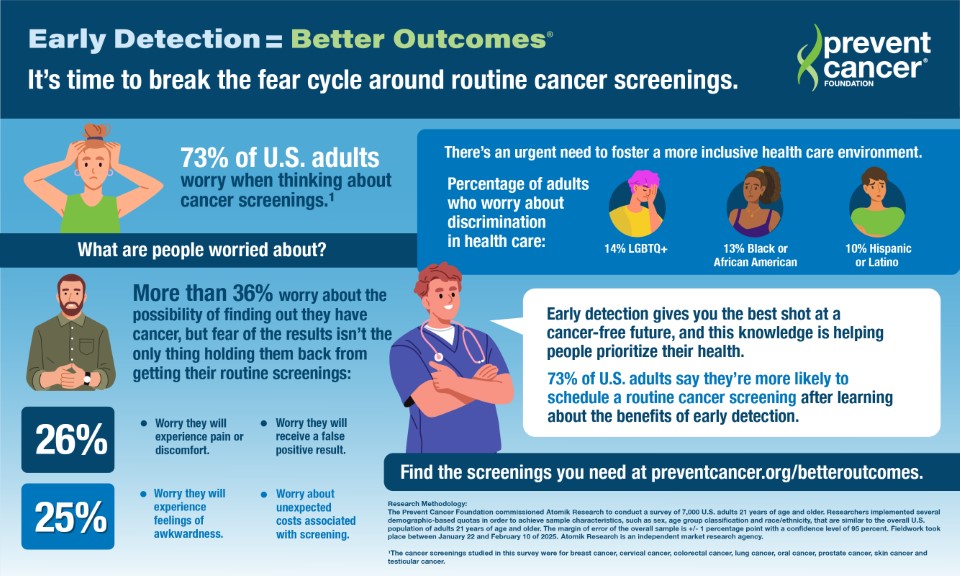
That’s according to the Prevent Cancer Foundation’s 2025 Early Detection Survey, which revealed 73% of U.S. adults worry when thinking about cancer screenings.2 This persistent fear continues to be a significant barrier to early detection—those who reported being worried about routine screenings were more likely to be behind on one or more recommended screenings (70%) compared to those without such worries (65%).
What are we worried about?
More than 36% of survey participants worry about the possibility of finding out they have cancer, and of that group, 39% believe that a cancer diagnosis is usually a death sentence. Beyond this overarching fear, many participants expressed anxieties about other aspects of the screening experience, including:
- More than one in four (26%) worry that they will experience pain or discomfort.
- More than one in four (26%) worry they will receive a false positive result.
- One in four (25%) worry about unexpected costs associated with screening.
- One in four (25%) worry that they will experience feelings of awkwardness.
There is an urgent need to foster a more inclusive health care environment.
Among minority populations in the United States, concerns about discrimination are more frequently reported by people of color and those who identify as LGBTQ+. It’s important to encourage health care providers to proactively address these concerns with their patients before, during and after the screening process. Fourteen percent of adults who identify as mixed race, “some other race,” or as LGBTQ+ report concerns about experiencing discrimination. Similarly, 13% of Black or African American adults share this concern.
Possible solutions
Education plays a powerful role in overcoming fear and encouraging action. In fact, 73% of U.S. adults say they’re more likely to schedule a routine cancer screening after learning about the benefits of early detection—a striking parallel to the 73% who report at least one worry when thinking about cancer screenings.
“We all know the phrase ‘knowledge is power,’ but when it comes to early detection, we really mean it,” said Jody Hoyos, CEO of the Prevent Cancer Foundation. “When people understand the lifesaving benefits of early detection, they’re more likely to take action. We must continue breaking down fear with facts and empowering people to check their health.”
Many patients are unaware of the progress that has been made in treatments for cancers that were detected early, but this information can make a difference when it comes to patient fear. In fact, 36% of survey participants said that access to information about recent medical advancements in cancer treatment and information on how early diagnosis can improve outcomes would motivate them to get their routine cancer screenings.
New and innovative tests may be another potential solution to reverse the decline in the number of people getting their routine cancer screenings. In the 2025 Early Detection Survey, 64% of adults who are behind on at least one routine cancer screening indicated they would be more likely to prioritize screening if there were innovative options such as at-home tests, different/less invasive tests or screenings, faster tests or less frequent tests.
And, there’s a need for additional support that U.S. adults say would help them stay on track with routine cancer screenings, including assistance from their health care provider, such as answering questions or helping them navigate the health care system (51%).
Remembering the benefits of early detection could do more than ease your mind the next time you’re at the doctor—it might just save your life. To learn what routine screenings you’re eligible for, visit Preventcancer.org/筛选.
Research Methodology: The Prevent Cancer Foundation commissioned Atomik Research to conduct a survey of 7,000 U.S. adults 21 years of age and older. Researchers implemented several demographic-based quotes in order to achieve ample characteristics, such as sex, age group classification, and race/ethnicity, that are similar to the overall U.S. population of adults 21 and older. The margin of error of the overall sample is +/- 1 percentage point with a confidence level of 95%. Fieldwork took place between January 22 and February 10 of 2025. Atomik Research is an independent market research agency.
1 American Cancer Society
2 The cancer screenings studied in this survey were for breast cancer, cervical cancer, colorectal cancer, lung cancer, oral cancer, prostate cancer, skin cancer and testicular cancer.
###
About the Prevent Cancer Foundation®
The Prevent Cancer Foundation® is the only U.S.-based nonprofit organization solely dedicated to cancer prevention and early detection. Through research, education, outreach and advocacy, we have helped countless people avoid a cancer diagnosis or detect their cancer early enough to be successfully treated. We are driven by a vision of a world where cancer is preventable, detectable and beatable for all.
基金会正奋起应对到 2035 年将癌症死亡人数减少 40% 的挑战。为实现这一目标,我们承诺投资 $2000 万美元用于创新技术,以早期发现癌症并推进多癌筛查,投资 $1000 万美元用于扩大医疗服务不足社区的癌症筛查和疫苗接种机会,并投资 $1000 万美元用于教育公众有关筛查和疫苗接种的选择。
如需了解更多信息,请访问 www.preventcancer.org.