Möglichkeiten der Darmkrebs-Vorsorge: Was ist das Richtige für mich?
Da sind viele Dickdarmkrebs screening options—but which one do you choose? Talk with your health care provider about your options to select the right screening for you. The best screening is the one that gets done, so despite potential discomfort, put it on the calendar.
Note: All time intervals indicated are for normal test results. You may have to get more frequent tests if you have increased colorectal cancer risk or if abnormal test results are found.
Visual Tests
Colonoscopy: Every 10 years
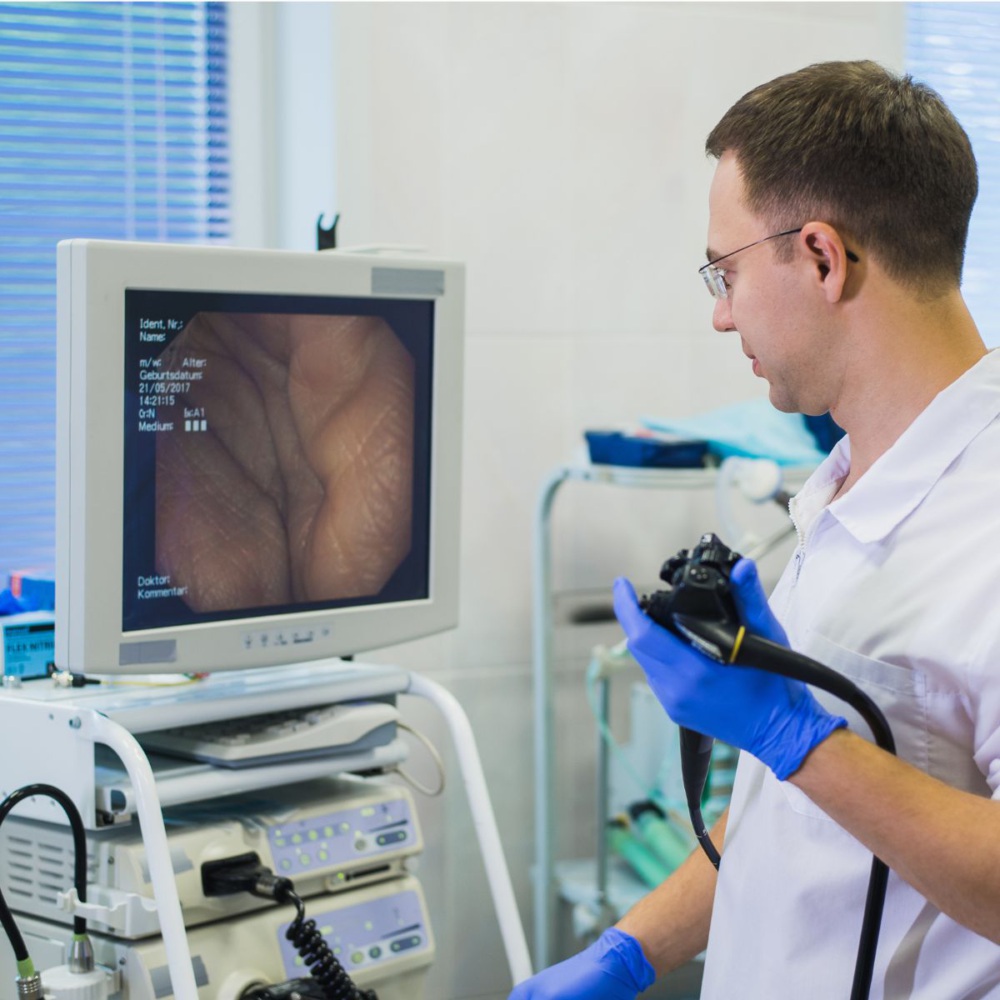
In this procedure, a tube with a light and a camera is inserted through the rectum into the colon to look for irregularities. With this procedure, your doctor can screen for cancer and find and remove precancerous polyps (growths), making it the only colorectal cancer screening type that is preventive. Before a colonoscopy, you would need to prepare by fasting for some time and drinking bowel preparation fluids or taking oral medication to clean out your colon. You are typically sedated during the procedure.
Note: If you take any of the other tests and get abnormal results, you must get a colonoscopy too.
LESEN SIE AUCH | You never forget your first time…getting a colonoscopy
Virtual colonoscopy: Every five years
Less invasive than a traditional colonoscopy, the virtual colonoscopy is a procedure where your doctor uses a CT-scan to examine the colon for abnormalities. It does require similar bowel prep to the colonoscopy, but no tubes are used and sedation is not required.
Flexible sigmoidoscopy: Every five years
With this procedure your doctor examines only the lower third of the colon (instead of the entirety, as with a colonoscopy). The procedure involves a tube with a camera so the doctor can view the inside of the colon. You would be required to cleanse your bowels with prep ahead of time, similar to the colonoscopy.
Stool-based tests
High sensitivity guaiac based fecal occult blood test (HS gFOBT): Every year
With this test, a stool sample is sent to a lab to detect if there are microscopic amounts of blood in the stool. After getting a kit from a health care provider, you can take the test at home and mail your sample. This test doesn’t require any modifications to your diet.
Fecal immunochemical test (FIT): Every year
This stool-based test is sent to a lab to detect if there is blood in the stool. After getting a kit from a health care provider, you can take the test at home and mail in your results. This test doesn’t require any modifications to your diet.
Multitarget stool DNA (mt-sDNA) test: Every three years
This stool-based test detects whether there are DNA mutations present in cells in your stool. This test also includes the FIT to look for blood in the stool. You take the test at home and mail your results to the lab.
Multi-target stool RNA (mt-sRNA) test: Every three years
This stool-based test detects whether there are RNA mutations present in cells in your stool. This test also includes the FIT to look for blood in the stool. You take the test at home and mail your results to the lab.
Blood-based tests
Blood test: Every three years
The blood-based test is recommended only for those who have declined or have not completed a visual or stool-based screening test. It requires having your blood drawn at a doctor’s office or lab. The blood sample is checked for DNA that could signal cancer.
For more information on colorectal cancer signs, symptoms and screening options, visit preventcancer.org/colorectal.